What is the Suzuki method?
The Mother Tongue Method. Suzuki students listen to recordings of beautiful classical music every day. With these recordings as examples of how to sound on their instruments, they develop a musical vocabulary—just as they learn to speak their native tongue by hearing it spoken around them from the time they are born, or earlier. Every child can learn to play what he or she has heard, just as every Chinese child will learn to speak Chinese and every French child will learn to speak French. Music, like language, is no longer reserved for only a “talented” few.
Children learn in small steps. When learning the mother tongue, the vocabulary is developed one word at a time. When learning violin, the student learns first to stand correctly, to sing one pitch at a time and to clap basic rhythms, then to hold a pretend bow and make a correct bowhold. Along with the more obvious lessons, the child is also learning focus and concentration. Short, daily practices with the parent reinforce what is learned in the lesson. Children can start at age two and spend much time on each step, or they can start much older–or as adults. Everyone can learn when there is a clear step-by-step process. When one step is mastered, the student goes on to the next step. Suzuki says, “Never hurry, never rest.”
Review. We don’t stop saying the word “and” just because we have learned other words. Suzuki students continue to play all the pieces they ever learned, building a musical repertoire just as we build a vocabulary while learning our mother tongue. Suzuki students improve as musicians by reviewing pieces they already know and by playing them at higher and higher levels. The review pieces become etudes in which new skills are added. It is much easier than having to learn whole new songs and new skills at the same time! Meanwhile, the students are building a vast repertoire of polished pieces and are ready to perform at any time. Students who have completed Suzuki Book 10 (Mozart concertos) still play Twinkle, Twinkle Little Star with their group class - and what a beautiful Twinkle it is!
Parents are involved. A parent works closely with his/her child to master the mother tongue; similarly, with Suzuki, the parent helps the child towards musical mastery. Parents attend every lesson and are responsible for teaching “home lessons” as the daily practice. Because the parent is the home teacher, the child learns exactly and improves vastly from week to week. This forms a special bond between parent and child, helping the parent learn to work constructively with the child and to begin to understand why Suzuki’s goal is not musical excellence, but world peace, which begins at home.
Music reading. Just as children first learn to speak their mother tongue, Suzuki students are first taught to “speak” (play fluently with beautiful tone and posture) and then are taught to read music. This way, they also read fluently earlier, with beautiful tone, intonation and understanding. When Suzuki first came to this country many years ago, however, teachers made a large mistake. They focused all their energy on playing by ear because that was the new and different thing–and it sounded great. They neglected to teach their students to read and we had a nationwide illiteracy crisis on our hands! Suzuki teachers learned from this first generation of illiterate students, and with the wisdom gained, now address note reading from the beginning stages. Vermont Suzuki students learn to recognize pitches (look and sing) and rhythms (look and clap) from their very first lessons. They learn perfect pitch at this time because they repeat the notes so often. They continue to clap and sing until their posture and tone are excellent; they begin to play and read music at the same time, usually around the age of five or six when they are also learning to read words. For each student, ear training and note reading advance at different paces until around Book Five or Six (Vivaldi Concert in G minor) when the skills merge. The most important thing is that they always play with beautiful tone, posture and intonation whether they are reading music or playing by ear. In other words, even when they are adding visual skills, they retain their aural skills–which is obviously vital for music, and which is unfortunately not the case for non-Suzuki students who only learn note reading without the ear training.
Suzuki environment is positive, fun and encouraging. Just as a child learning the mother tongue is not scorned for not pronouncing a word in a certain way, a Suzuki student is never spoken to harshly for playing a wrong note. S/he is simply given a specific note (word) to practice over and over, with much praise when it is mastered! “Success breeds success,” says Suzuki. When a student does something well, and is affirmed for that success, s/he will love to repeat it many times. Students are never asked to do something they cannot do; tasks are always broken down into small steps to ensure success. Students become confident and sure of themselves. The Suzuki method is not about making musicians; it is about building self-esteem.
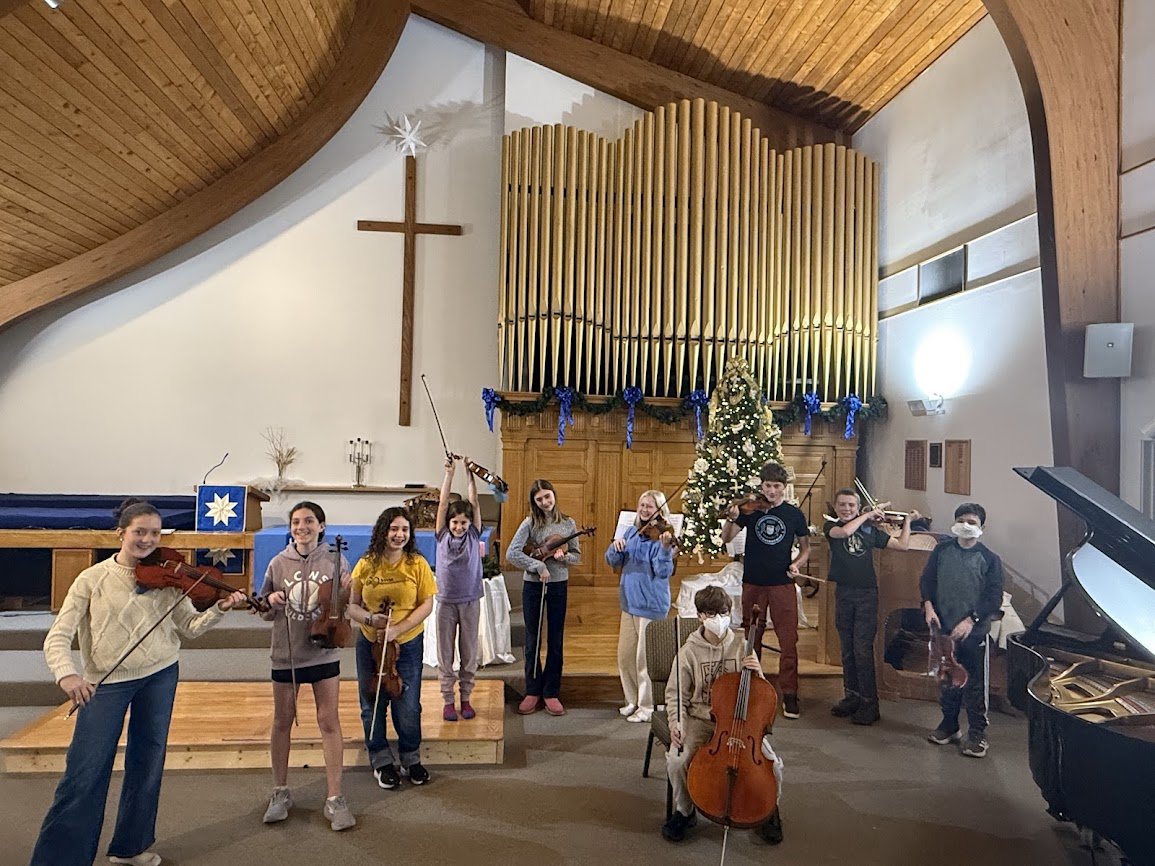
Playing a Suzuki instrument is a social activity. Babies are surrounded by people speaking their mother tongue. Similarly, Suzuki felt it was important for his students to have a peer group of musicians. So, in addition to their weekly private lessons, all Suzuki students attend Group Class. “Group” provides an opportunity for all the detailed home practice and lessons to be put to use. All Suzuki students listen to the same repertoire and learn basically in the same manner, so a Suzuki student can travel anywhere in the world and play music with any Suzuki student–and they do! For example, a Vermont Suzuki student went on a sabbatical with her family and easily joined a Swedish Suzuki program, continuing on where she had left off here. At World Suzuki conferences, children meet and play together, using their common musical language to communicate. In Northern Israel, there is a Suzuki program where Arab children and Israeli children learn and play together, despite the separation in every other area of their lives. This is what Dr. Suzuki meant when he said that he is creating world peace through the hearts of young children.
Suzuki students are polite, respectful and noble human beings. They are trained in discipline, focus, respect, teamwork and confidence. The instruments they are learning are vehicles for these broader goals. They may not play their instruments forever, but they will always have the skills they have learned: self-discipline, listening, concentration—which can apply to every area of life. It is a great honor to be involved with millions of Suzuki parents, teachers and students worldwide who are all at work on making this world an even better place to live.
The man behind the method:
He gave the gift of much more than music to children all over the world, as he tells in his autobiography, “Nurtured By Love”.